One Product Suite, One Lifecycle
Six products, built over the self-learning, self-improving systems we already run, that carry your strategy through design, build, and operation — and compound what each phase learns into your enterprise knowledge graph.
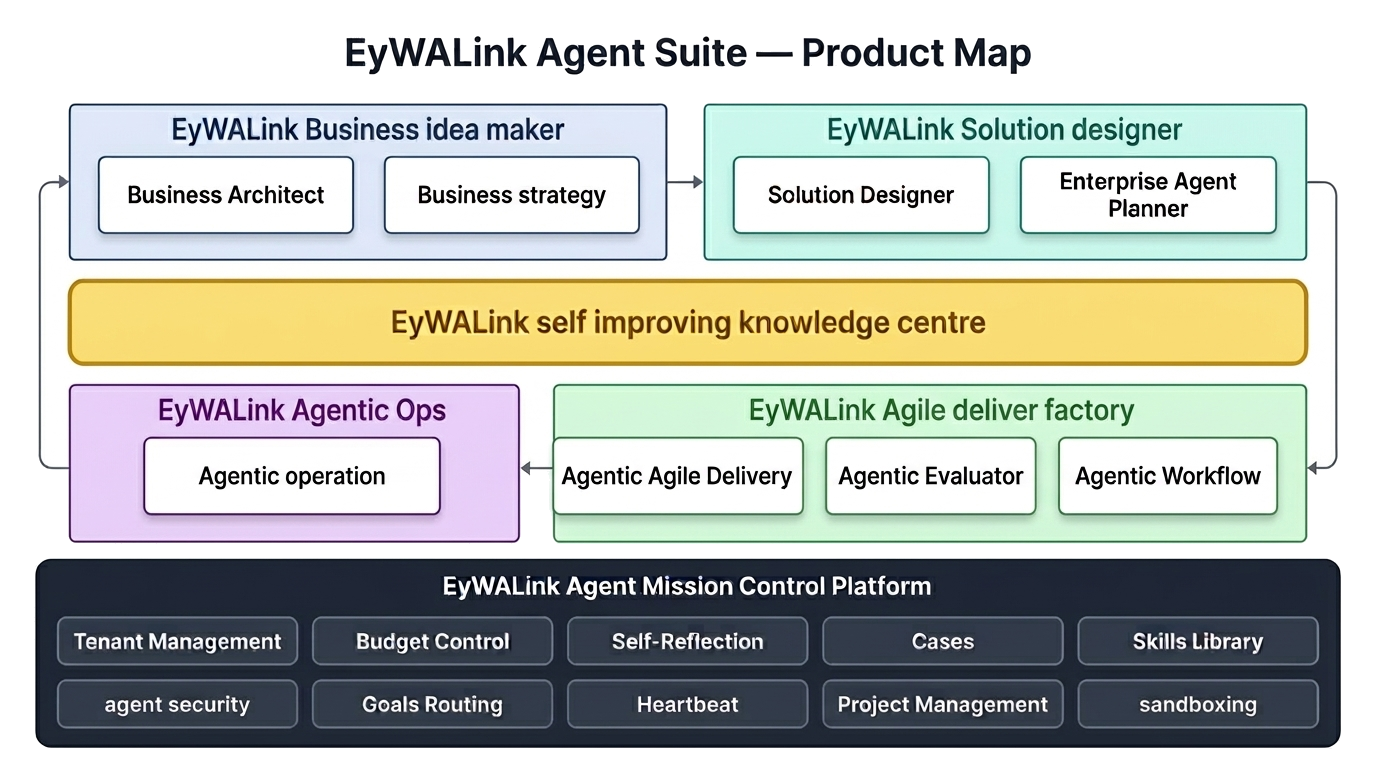
How the Products Map to Your Lifecycle
Each product owns one of the four phases introduced on our About page — plus a knowledge hub that crosses all of them.
Business Idea Maker turns the idea into a buildable architecture and agent plan.
See products ↓Solution Designer turns that into a sprint-sized reference and technical architecture.
See products ↓Agile Delivery Factory builds and verifies the system in one self-healing loop.
See products ↓AgentOps monitors, diagnoses, and improves the running system.
See products ↓The Self-Improving Ontology — the hub every phase reads from and writes to.
See products ↓The governance and audit boundary that spans the whole lifecycle.
See products ↓Six products, loosely coupled, can be configured and run on your private cloud/on-prem,
EYwALINK Business Idea Maker
Strategy and agent plan, in one.
Turns a business idea into a buildable enterprise architecture and a concrete agent plan — the full TOGAF ADM as executable commands, plus which agents you need and how they hand off, not a 200-page deck.
When to use
You have a strategy on paper but no buildable plan behind it — you can't say whether it will actually ship, what it costs, or which agents you'd need to run it.
How it works
It runs the TOGAF ADM as executable commands — each step emits a machine-readable artefact (capability map, application inventory, gap analysis, transition plan) — then designs the agent layer on top: who does what, where a human holds the gate, and how it is governed.
arckit-togaf-adm + agentic EA Explore the method EYwALINK Solution Designer
Sprint-sized architecture.
Reference and technical architecture in 1–2 page, sprint-ready canvases — model selection per workload, vector store and GPU sizing, and the transition waves to get there. Buildable in weeks, not quarters.
When to use
You know what you're building but not what it runs on — which model fits each workload, how to size the vector store and GPUs, and how to get there in waves.
How it works
It turns the target architecture into 1–2 page sprint canvases — model per workload, infra sizing, and the transition waves — each one buildable in a sprint, not a quarter.
arckit-oaa Read the whitepaper EYwALINK Agile Delivery Factory
Build, verify, ship — one loop.
A self-improving delivery loop that turns the plan into running, verified software: it builds, then proves the build with a four-phase E2E gate — and only ships when the tests pass.
When to use
You've got the architecture in hand but it still has to be built, tested, and shipped — and the hand-offs between those steps are where most projects quietly fall apart.
How it works
A LangGraph loop takes the spec, generates the plan and code, then reads the source to pull out form schemas and validation rules, drives a real browser, and correlates the server logs — shipping only at a VERIFY gate when the machine-checkable tests pass. The patterns it learns are stored, so the next run starts smarter.
loop-factory + super-eval-test How the loop works EYwALINK AgentOps
The ops team that improves.
A self-hosted observability stack plus an agentic ops team that monitors, diagnoses, hot-fixes, and improves the running system — then compounds what it learns back into the hub.
When to use
You have agents in production and no single place to see what they're doing, who owns each one, or what it did last night — and no one watching the stack until something breaks.
How it works
A full observability stack (dashboards, logs, metrics, alerts) is wired into the running system, and an agentic ops team monitors it, diagnoses regressions, hot-fixes, and ships improvements — then writes the learnings into the Self-Improving Ontology so the next cycle starts smarter.
eywalink-observability + agentic ops Read the AgenticOps whitepaper EYwALINK Self-Improving Ontology
The memory of the suite.
A private, ontology-defined knowledge graph every product reads from and writes to — so each phase starts from what the last one learned, not from zero.
When to use
Your agents live in silos — each one re-derives the same facts from scratch, and nothing a phase learns carries into the next one.
How it works
Every product writes its outputs into a private, ontology-defined knowledge graph (Qdrant + Neo4j) and grounds itself on what's already there, so each new cycle starts from accumulated knowledge instead of zero.
digital-twins Browse resources EYwALINK Control Plane
The governance spine.
A custom multi-tenant control plane: tenancy, credential isolation, a full audit trail, and the per-tenant workflow runtime — so the whole lifecycle stays sovereign and auditable.
When to use
You want each client or tenant running their own private AI workflows and agents on your infrastructure — but without giving up governance, audit, or isolation.
How it works
A multi-tenant control plane runs the per-tenant workflow runtime (self-hosted LLM workflows, RAG knowledge bases, MCP tools — one instance per tenant), isolates each client's tenancy and credentials, and keeps a full audit trail of every action, governed and audited like everything else.
custom multi-tenant agentic plane Browse resources Built to stay yours
Every layer is self learning and improving software. No proprietary engine, no licensing risk.
Private models, private vector stores, private knowledge. Nothing leaves your infrastructure.
You own the models, the data, and the stack. Migrate or retire anything, on your terms.
AgenticOps gives each business user a direct, private line — natural language over the chat they already use — to run and manage their own day-2. No IT ticket; the system pops back to the person only at irreversible calls.
Read the AgenticOps whitepaperWant to see this suite run in your environment?
Book a Free Strategy Session