One Product Suite, One Lifecycle
Eight products, built over the self-learning, self-improving systems we already run, that carry your strategy through design, build, and operation — and compound what each phase learns into your enterprise knowledge graph.
How the Products Map to Your Lifecycle
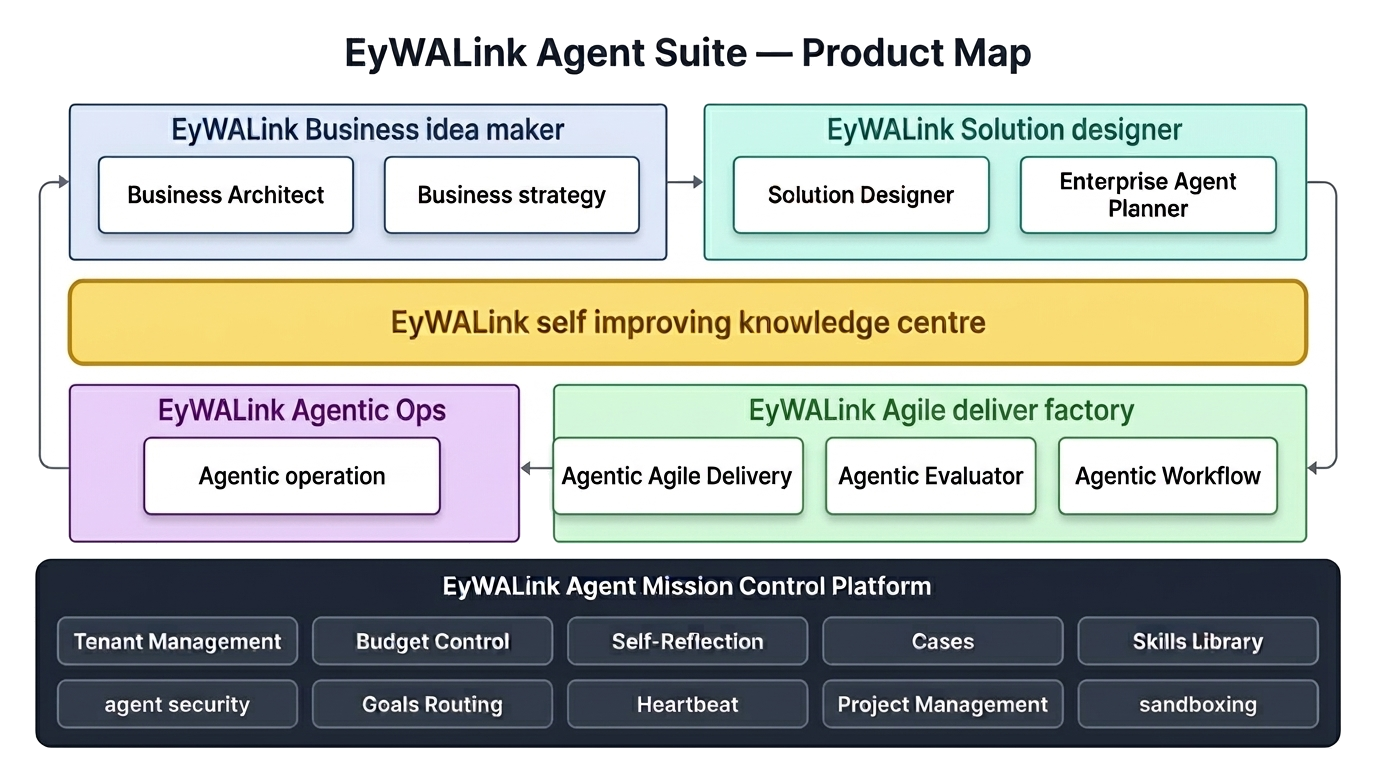
Each product owns one of the four phases introduced on our About page — plus a knowledge hub that crosses all of them.
Business Architect sets the enterprise baseline.
See products ↓Solution Designer + Agent Planner turn it into a buildable spec and agent plan.
See products ↓Delivery, Evaluator, and (per tenant) Workflow turn the plan into running software.
See products ↓Mission Control runs the agents and watches the stack.
See products ↓The hub every phase reads from and writes to.
See products ↓Eight products, loosely coupled, can be configured and run on your private cloud/on-prem,
EYwALINK Business Architect
Strategy that ships.
Turns a business idea into a buildable enterprise architecture — the full TOGAF ADM as executable commands and fundable milestones, not a 200-page deck.
When to use
You have a strategy on paper but no buildable plan behind it — you can't say whether it will actually ship, or what it costs to get there.
How it works
It runs the full TOGAF ADM as executable commands: each step emits a machine-readable artefact (capability map, application inventory, gap analysis, transition plan) you can hand straight to a delivery team.
arckit-togaf-adm Explore the method EYwALINK Solution Designer
Sprint-sized architecture.
Reference and technical architecture in 1–2 page, sprint-ready canvases — model selection per workload, vector store and GPU sizing, and the transition waves to get there. Buildable in weeks, not quarters.
When to use
You know what you're building but not what it runs on — which model fits each workload, how to size the vector store and GPUs, and how to get there in waves.
How it works
It turns the target architecture into 1–2 page sprint canvases — model per workload, infra sizing, and the transition waves — each one buildable in a sprint, not a quarter.
arckit-oaa Read the whitepaper EYwALINK Enterprise Agent Planner
A buildable agent plan.
Designs the agent layer: which agents, what each does, how they hand off, where a human holds the gate, and how it is governed and secured — from inventory to orchestration plan.
When to use
You want to develop and deploy agents to your company, but you don't know whether they overlap, are secured or safe to work, or whether they're cost-effective.
How it works
It scans your environment and document library to produce an agent assessment.
arckit-agent-architecture Read the whitepaper EYwALINK Agentic Agile Delivery
A self-healing delivery loop.
A self-improving LangGraph loop that takes your architecture and ships working software end to end — with human-in-the-loop gates and a VERIFY gate that loops until acceptance tests pass.
When to use
You've got the architecture in hand, but it still has to be built, tested, and shipped — and the hand-offs between those are where most projects quietly fall apart.
How it works
A LangGraph loop takes the spec, generates the plan and code, then runs machine-checkable acceptance tests at a VERIFY gate and only ships when they pass; the patterns it learns are stored so the next run starts smarter.
loop-factory How the loop works EYwALINK Agentic Evaluator
Quality as a first-class step.
A four-phase E2E test pipeline: read the source, generate realistic test data, drive a real browser, and correlate server-side logs — so a build only counts when you can prove it works.
When to use
You want proof a build works before you call it done — not a “trust me” from the agent that wrote it.
How it works
It reads the source to pull out the form schemas and validation rules, generates realistic test data from that, drives a real browser through the app, then correlates the results against the server-side logs.
super web testing Browse resources EYwALINK Compounding Knowledge Graph
The memory of the suite.
A private knowledge graph every product writes to and grounds itself on — ingest, embed, link, and curate across every phase, so the next strategy cycle starts already smarter.
When to use
Your agents live in silos — each one re-derives the same facts from scratch, and nothing a phase learns carries into the next one.
How it works
Every product writes its outputs into a private knowledge graph (Qdrant + Neo4j) and grounds itself on what's already there, so each new phase starts from the accumulated knowledge instead of zero.
digital-twins Browse resources EYwALINK Agent Mission Control
The operating plane.
A multi-tenant control plane for the agent org: runs the agents, isolates each client, keeps a full audit trail of every action, and wires observability into the stack.
When to use
You have agents in production and no single place to see what they're doing, who owns each one, or what it did last night.
How it works
It is a multi-tenant control plane: it runs the agents, isolates each client's tenancy, keeps a full audit trail of every action, and wires observability in so you can watch the stack behave.
multi-tenant Paperclip Browse resources EYwALINK Agentic Workflow
A per-tenant workflow platform.
Self-hosted LLM workflows, RAG knowledge bases, and MCP tooling — deployed one instance per tenant and wired into Mission Control, so it is governed and audited like everything else.
When to use
You want each client or tenant running their own private AI workflows on your infrastructure — but without giving up governance, audit, or the control plane.
How it works
One self-hosted instance is spun up per tenant, carrying that tenant's LLM workflows, RAG knowledge bases, and MCP tools, then wired into Mission Control so it is governed and audited like everything else.
Built to stay yours
Every layer is self learning and improving software. No proprietary engine, no licensing risk.
Private models, private vector stores, private knowledge. Nothing leaves your infrastructure.
You own the models, the data, and the stack. Migrate or retire anything, on your terms.
AgenticOps gives each business user a direct, private line — natural language over the chat they already use — to run and manage their own day-2. No IT ticket; the system pops back to the person only at irreversible calls.
Read the AgenticOps whitepaperWant to see this suite run in your environment?
Book a Free Strategy Session